


Best Setup Guide for Hydroponic Tomatoes in Australia: EC, pH, Trellising and Summer Heat
By Hydro Experts | 21 October 2026
Set up hydroponic tomatoes in Australia with the right system, EC and pH ranges, trellising, nutrients and summer heat management. Includes a final setup checklist and FAQs.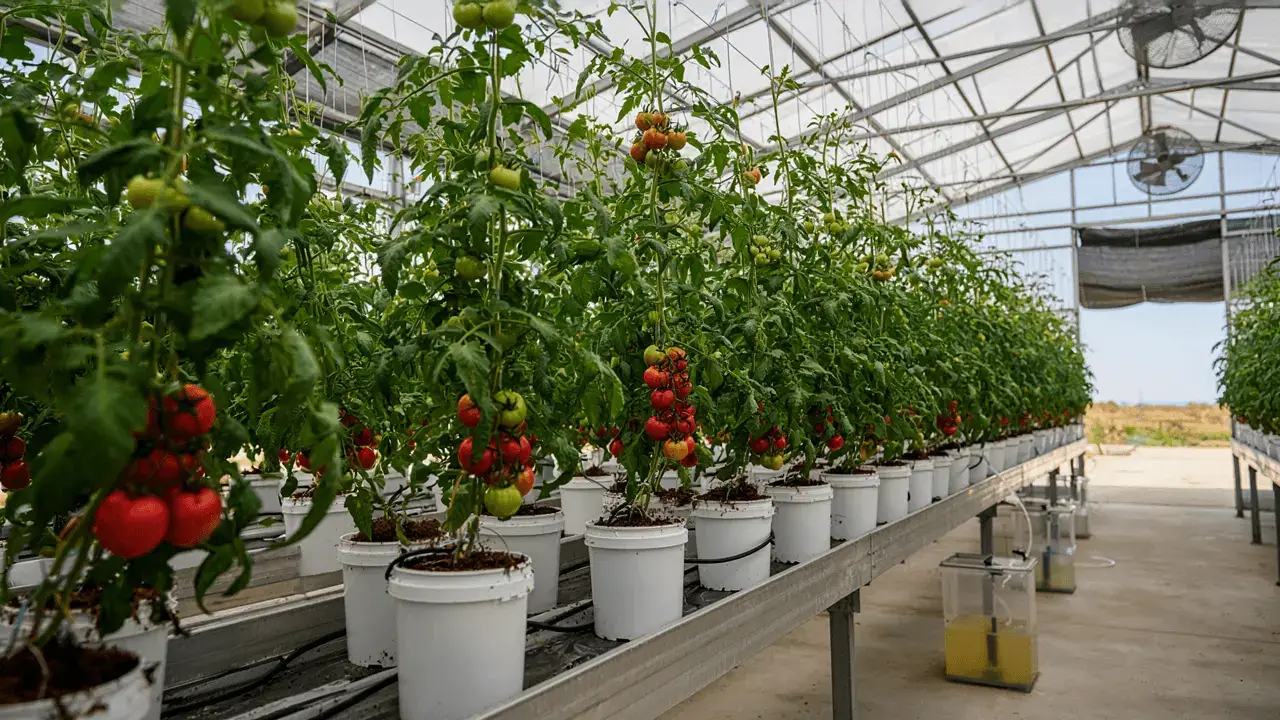
Growing tomatoes hydroponically gives you control over nutrient delivery, watering and the root environment. It can also help you make better use of limited space, whether you are growing cherry tomatoes on a patio or training indeterminate vines in a greenhouse.
Australian summers bring an extra challenge. High temperatures can stress plants, reduce flower pollination and push water demand up quickly. A reliable setup needs more than the right nutrient bottle. You need a suitable growing system, balanced EC and pH, strong support for mature vines and a plan for managing heat.
This guide covers the essentials for growing hydroponic tomatoes in Australia, from choosing your system to troubleshooting fruiting problems.
Quick Insights: Hydroponic Tomato Growing Setup in Australia
Growing hydroponic tomatoes successfully in Australia requires the right growing system, balanced nutrients, reliable plant support and careful summer heat management. Monitor EC, pH and root-zone conditions as plants move from vegetative growth to fruiting.
- Best growing systems: Drip irrigation with coco coir and Dutch bucket systems are practical options for tomatoes. DWC and ebb-and-flow can also work with adequate root space and system management.
- EC levels: Hydro Experts lists 2.2–2.8 mS/cm as a tomato reference range. Start lower for seedlings (around 0.8–1.2 mS/cm) and increase gradually as plants mature.
- pH range: Aim for approximately 5.8–6.2 as a working target, checking regularly with a calibrated pH meter.
- Nutrient requirements: Use a complete hydroponic nutrient suitable for fruiting crops, with balanced nitrogen, phosphorus, potassium, calcium, magnesium and micronutrients.
- Trellising and pruning: Install supports early. Indeterminate varieties need strong vertical support and regular training, while determinate varieties generally require less intensive pruning.
- Summer heat management: Use suitable shade cloth, ventilation and airflow. Protect reservoirs and irrigation lines from direct sunlight, monitor root-zone temperature and maintain consistent water delivery.
- Flower pollination and fruiting: Gentle vibration or airflow can help move pollen in protected growing areas. Excessive heat can reduce pollen viability and fruit set.
- Common problems: Blossom-end rot, yellowing leaves, poor fruit set, wilting and cracked fruit can result from nutrient, irrigation, pollination or environmental issues. Check system conditions before changing nutrient strength.
Bottom line: Maintain suitable EC and pH, support tomato vines before they become heavy, and prepare for Australian summer heat early. Consistent monitoring of nutrients, water supply, temperature and plant health is key to a productive harvest.
1. Choose the Right Hydroponic System for Tomatoes
Tomatoes develop substantial root systems and can become heavy once fruit begins to mature. Choose a system that provides enough root space, reliable irrigation and support for the plant's eventual size.
Common options include:
- Drip irrigation with coco coir: Nutrient solution is delivered directly to each plant through drippers. Coco coir provides root support and retains moisture while allowing drainage when managed correctly. This is a practical option for home growers and larger setups.
- Dutch bucket systems: Individual buckets hold the growing medium, with nutrient solution delivered through irrigation lines. They are useful for larger tomato plants and make it easier to manage individual growing sites.
- Ebb and flow: A tray or growing area is periodically flooded with nutrient solution before draining. The system can support larger plants when designed with suitable root space and structural support.
- Deep water culture (DWC): Roots sit in an oxygenated nutrient solution. DWC can grow tomatoes, but mature plants need adequate reservoir capacity, dependable aeration and careful temperature management.
For beginners, a small drip-fed system with coco coir or a suitable Dutch bucket setup can be easier to manage than a complex recirculating installation.
Browse Hydro Experts' hydroponic systems to compare available options.
Prone to blocked emitters? Read how to prevent and troubleshoot clogged drip lines, or compare coco, clay pebbles and rockwool before you choose a medium.
2. Select a Suitable Tomato Variety
Your variety affects how much space, support and maintenance the system needs.
- Cherry tomatoes: Often a practical starting point because many varieties produce well in home gardens and containers.
- Determinate tomatoes: These have a more compact, limited growth habit. They may suit smaller growing spaces, although support is still useful when plants carry heavy fruit.
- Indeterminate tomatoes: These continue growing and producing fruit through the season under suitable conditions. They need more vertical space, regular training and ongoing pruning.
Check the seed packet for growth habit, expected plant size and suitability for your local climate. A variety that performs well in a cool greenhouse may struggle through a hot Australian summer without environmental control.
3. Get EC Right for Hydroponic Tomatoes
EC stands for electrical conductivity. It indicates the concentration of dissolved salts in your nutrient solution and provides a practical way to monitor nutrient strength.
Tomatoes generally need a stronger nutrient solution than leafy greens, but the target changes as plants grow.
Hydro Experts' crop reference lists tomatoes at EC 2.2–2.8 mS/cm. Treat this as a reference range, not an instruction to run every plant at the upper end from the seedling stage onwards.
A practical starting framework is:
| Growth stage | General EC starting range |
|---|---|
| Seedlings and young plants | 0.8–1.2 mS/cm |
| Established vegetative growth | 1.4–2.0 mS/cm |
| Flowering and fruiting | 1.8–2.8 mS/cm |
These are general starting ranges. Follow your nutrient manufacturer's feeding chart and adjust for variety, growing medium, source water and plant response. Some tomato crops and nutrient programmes will require different targets.
How to manage EC
- Measure the EC of your source water before adding nutrients.
- Add a complete hydroponic tomato nutrient according to its instructions.
- Measure the mixed solution and adjust gradually.
- Monitor EC and water use regularly as the plant matures.
- Record readings so you can spot changes rather than making random adjustments.
If water levels fall while EC rises, plants may be taking up water faster than nutrients, or salts may be accumulating. If EC falls, nutrient uptake may be outpacing water uptake. These patterns are clues, not diagnoses, so check plant condition and the full system before changing the feed.
Hot weather can increase water demand and make a strong nutrient solution harder for stressed plants to manage. Avoid increasing EC simply because growth has slowed.
For more detail, read Hydro Experts' guide to EC for hydroponics.
Need a reliable reading? Browse EC and pH meters, and see what conductivity is and why it is important.
4. Maintain the Correct pH
pH affects how readily roots can absorb nutrients. Even if your reservoir contains the right minerals, an unsuitable pH can limit nutrient availability.
A practical working target for many hydroponic tomato systems is around 5.8–6.2, adjusted according to your nutrient programme and the crop's response.
Check pH regularly, particularly in recirculating systems where plant uptake and water chemistry can shift the solution over time.
pH management tips
- Calibrate your pH meter according to the manufacturer's instructions.
- Test the solution after mixing nutrients and before making adjustments.
- Make small corrections rather than large changes at once.
- Check pH again after adjustment.
- Investigate repeated swings instead of continually adding pH-up or pH-down products.
Australian tap water varies by region. If your source water has a high starting EC or alkalinity, it can affect nutrient management. Measure it before deciding how much adjustment is required.
Do not confuse pH with EC. pH measures acidity or alkalinity; EC indicates dissolved salt concentration. Both matter, and neither tells you the full nutrient composition on its own.
See Hydro Experts' guide to pH control for Australian hydroponics.
Keep your meter accurate with the guide to pH and EC pen calibration and maintenance.
5. Choose a Complete Tomato Nutrient
Tomatoes need a balanced supply of essential nutrients throughout their growth cycle. Their needs change as they move from leaf and stem development into flowering and fruit production.
A suitable hydroponic nutrient programme should provide:
- Nitrogen: Supports leaf and stem growth. Excessive nitrogen can encourage lush foliage at the expense of balanced fruit production.
- Phosphorus: Supports energy transfer, root development and reproductive growth.
- Potassium: Plays an important role in water regulation and fruit development.
- Calcium: Supports cell walls and healthy growing tissues.
- Magnesium: Forms part of chlorophyll and supports photosynthesis.
- Micronutrients: Iron, manganese, boron and other trace elements support normal plant functions.
Use a nutrient formulation designed for hydroponics and appropriate for fruiting crops. If you use a two-part product, follow the mixing order and dosage instructions. Never mix concentrated nutrient parts directly together unless the manufacturer explicitly instructs you to do so.
Browse Hydro Experts' hydroponic nutrients to compare products and feeding systems.
Compare feeding programmes in single-part vs multi-part hydroponic nutrients, or explore ready-made hydroponic nutrient kits.
6. Trellis and Prune Tomatoes Before They Get Too Large
Tomato vines become heavier as they grow, particularly when several fruit clusters develop at once. Install your support system early, before stems become difficult to handle.
Trellising options
- Vertical string: Suspend a strong string from a secure overhead support and train the vine upward. This works well in greenhouses with sufficient headroom.
- Trellis netting: Useful for smaller plants or setups where vines can be spread across a supported frame.
- Stakes or cages: Often suit determinate varieties and smaller home gardens. Make sure the structure can handle the weight of mature plants and fruit.
Secure overhead supports to a structure designed to carry the load. Do not assume a lightweight grow-tent frame or improvised hook can support a mature fruiting vine.
Pruning and training
For indeterminate tomatoes, train the main stem along the support and inspect new side shoots regularly. Removing selected suckers can help manage growth and improve access around the plant.
Avoid stripping too many leaves. Healthy foliage supports photosynthesis and protects fruit from direct sunlight. Excessive pruning can expose tomatoes to sunscald and reduce the plant's ability to support fruit development.
Determinate varieties often need less aggressive pruning. Follow the variety's growth habit rather than applying the same pruning routine to every tomato.
7. Manage Australian Summer Heat
Heat is one of the biggest challenges for hydroponic tomatoes. High temperatures can increase transpiration, stress roots and interfere with pollen function and fruit set. Warm nights can also make recovery difficult.
The best approach is to manage air temperature, root-zone conditions, light and water supply together.
Reduce heat around the plants
- Use shade cloth when direct summer sun becomes excessive, choosing a level of shading that still provides adequate light for fruiting.
- Improve greenhouse ventilation with appropriately sized exhaust and intake fans.
- Maintain airflow around the canopy without directing damaging, high-speed airflow at the plants.
- Monitor temperature at plant height rather than relying only on an outdoor weather forecast.
- Where growing indoors, account for the heat generated by grow lights and other equipment.
In very hot conditions, ventilation alone may not be enough. Consider additional climate control if temperatures remain excessive.
Keep the root zone stable
Hydroponic reservoirs and irrigation lines can heat up quickly in direct sun. Use opaque reservoirs, shade exposed containers and check nutrient solution temperature during the hottest part of the day.
In DWC systems, warm water holds less dissolved oxygen, so reliable aeration and temperature control are particularly important. In drip systems, check that emitters are delivering consistently and that the growing medium does not dry out between irrigations.
Adjust watering carefully
Tomatoes may use considerably more water during hot weather. Check reservoir levels and growing media more frequently, and make sure the irrigation schedule meets demand.
Do not respond to every sign of wilting by increasing nutrient strength. Wilting can result from heat stress, inadequate water delivery, damaged roots or high EC. Diagnose the likely cause before changing the nutrient mix.
Cooling the root zone? Read about the temperature challenge in Australian hydroponics, the benefits of water chillers for hydroponics, and how to cool your greenhouse. Track conditions with thermometers and hygrometers and browse water chillers and heaters.
8. Help Flowers Set Fruit
A healthy tomato plant can produce plenty of flowers but still yield poorly if temperatures or pollination conditions are unsuitable.
Tomato flowers generally self-pollinate, but pollen still needs to move within the flower. In a protected growing area, gentle vibration of flower clusters or suitable airflow can help release pollen.
During prolonged hot weather, pollen viability and fruit set may decline. Improve ventilation, provide appropriate shade and avoid allowing the root zone to overheat. Where possible, choose planting dates that allow flowering and early fruit development to occur under more favourable conditions.
Avoid excessive nitrogen feeding when plants are already producing abundant foliage but few fruits. Check light, temperature, EC and pH before changing the nutrient formulation.
9. Common Hydroponic Tomato Problems
- Blossom-end rot: A dark, sunken patch develops at the base of the fruit. It is associated with inadequate calcium reaching developing fruit, often due to inconsistent water supply or environmental stress. Check irrigation, root health, EC and pH before adding calcium.
- Yellowing leaves: This may indicate a nutrient issue, pH-related uptake problem, root stress or natural ageing. Check measurements and identify which leaves are affected before changing the feed.
- Lots of leaves, few tomatoes: Excessive vegetative growth, unsuitable temperatures, inadequate light or poor pollination may be involved. Review the growing conditions before reducing nitrogen.
- Wilting in the afternoon: Heat and high water demand may temporarily outpace root uptake, but persistent wilting needs investigation. Check irrigation delivery, root health, reservoir temperature and EC.
- Cracked fruit: Rapid changes in water availability can contribute to cracking as fruit expands. Keep irrigation consistent and avoid large swings between dry conditions and heavy watering.
Final Setup Checklist
Before your tomato plants enter their main growth and fruiting stages, check that you have:
- A system with enough root space and reliable drainage or circulation.
- A complete hydroponic nutrient suitable for tomatoes.
- Working pH and EC meters.
- A secure trellis or support structure.
- Adequate ventilation and a summer shading plan.
- A way to monitor reservoir or root-zone temperature.
- A routine for checking water levels, nutrient readings and plant health.
A productive hydroponic tomato garden comes from consistent management. Start with sensible EC and pH targets, support vines before they become heavy, and prepare for hot weather before plants begin to struggle. Record what works in your climate and adjust the system based on measured conditions rather than guesswork.
FAQs
Young plants generally need a lower nutrient concentration, while established fruiting plants may require more. Follow your nutrient manufacturer's chart and adjust to the crop's stage and conditions.
Hydroponic tomatoes are commonly grown within pH 5.5–6.5. A working target around 5.8–6.2 suits many systems, but check the instructions for your nutrient programme and monitor the solution regularly.
Provide ventilation, use suitable shade during intense sun, protect reservoirs from direct sunlight and monitor root-zone temperature. Increase monitoring during heatwaves, when plants can use water more quickly and fruit set may decline.
Indeterminate varieties generally need strong vertical support because their vines continue growing and become heavy with fruit. Determinate varieties may need less support, but stakes or cages can still help prevent stems and branches from collapsing.
Poor fruit set can result from excessive heat, unsuitable humidity, inadequate pollination, poor light or nutrient imbalances. Check the growing environment, support pollination in protected spaces and verify pH and EC before changing nutrients.