


How Many Air Stones Per Litre? Air Pump Sizing for DWC and Reservoirs
By Hydro Experts | 14 October 2026
Work out how many air stones 7 what air pump size you need for DWC & hydroponic reservoirs. Airflow chart by litre, placement tips & Australian summer advice.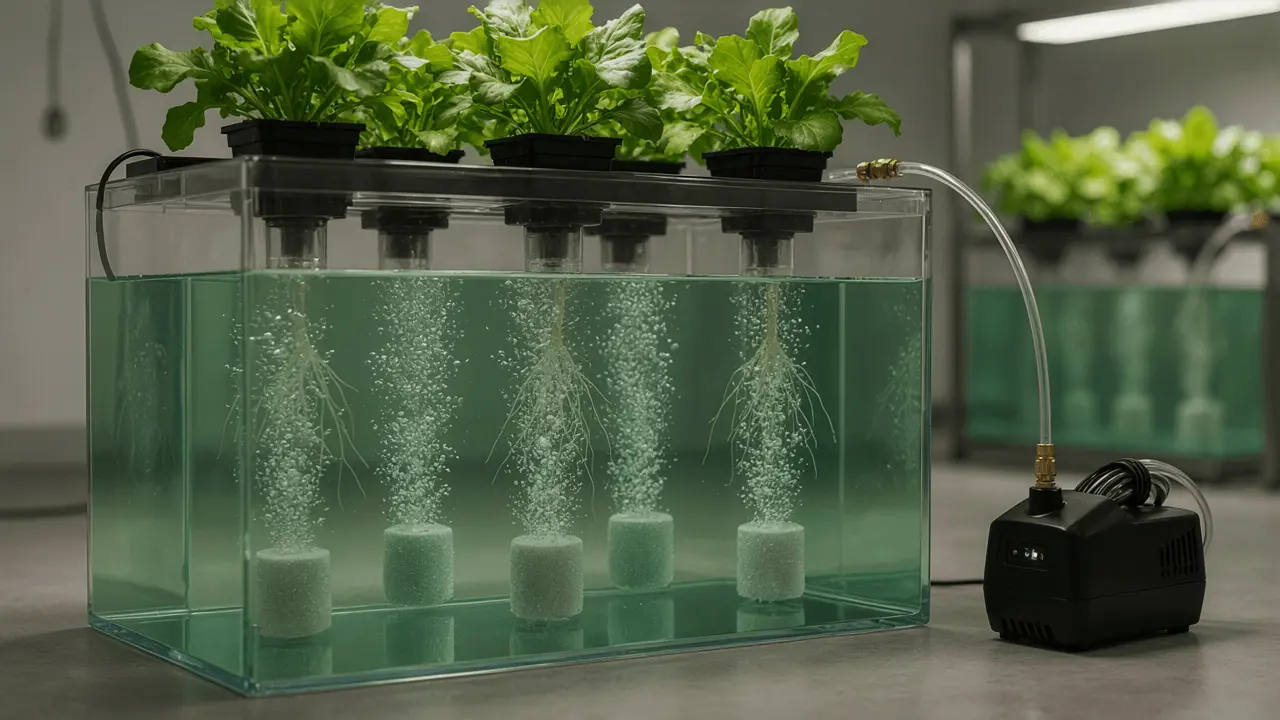
Choosing the right air pump and number of air stones is an important part of running a deep water culture (DWC) hydroponic system. Too little aeration can leave plant roots short of oxygen, while an oversized pump may add unnecessary cost, noise and energy use.
The challenge is that there is no universal rule for how many air stones you need per litre of nutrient solution. Reservoir volume matters, but so do water depth, air-stone size, pump output, root mass and water temperature.
This guide explains how to estimate air-pump capacity, distribute air stones across a reservoir and adjust your setup for Australian growing conditions.
Quick Insights: Air Pump Sizing and Air Stones for DWC
Choosing the right DWC air pump depends on reservoir volume, water depth, diffuser resistance and temperature. There is no universal number of air stones per litre; the goal is to provide enough airflow and distribute it evenly throughout the nutrient solution.
- Starting airflow ratio: Hydro Experts recommends 1 L/min of airflow for every 4 litres of nutrient solution as a starting estimate.
- Airflow examples: A 20L reservoir starts at an estimated 5 L/min, while 40L needs 10 L/min, 100L needs 25 L/min and 200L needs 50 L/min.
- Air stone quantity: One suitably sized stone may work for a small 20L bucket. Larger reservoirs may need multiple stones to achieve even bubble distribution.
- Pump selection: Check both airflow (L/min) and pressure capacity. Actual output can drop when air moves through tubing and stones at operating depth.
- Air stone placement: Position stones near the bottom and spread them across the reservoir to improve aeration coverage.
- Temperature matters: Warm water holds less dissolved oxygen. Australian growers should monitor reservoir temperature, limit sunlight exposure and consider a water chiller during hot conditions.
- Continuous aeration: Traditional DWC systems generally need air pumps running 24 hours a day, including overnight.
- Signs of poor aeration: Weak or uneven bubbles, wilting plants, slimy roots and unusual root-zone smells can indicate problems that need investigation.
Why Do DWC Systems Need Air Stones?
In DWC, plant roots grow directly into a nutrient solution. Unlike soil-grown roots, submerged roots depend on dissolved oxygen in the water for respiration and healthy function.
An air pump pushes air through tubing and into an air stone. The stone releases bubbles into the reservoir, helping oxygen move into the water. It also creates movement that can improve the distribution of oxygenated water.
Effective aeration supports:
- Healthy root respiration and nutrient uptake.
- More consistent oxygen availability around submerged roots.
- Better root-zone conditions as plants mature.
- Reduced risk of oxygen depletion when water temperatures rise.
Air stones do not guarantee a particular dissolved oxygen level. Bubble size, water depth, temperature and reservoir circulation all affect how efficiently oxygen transfers into the solution.
New to aeration? Read Airstone vs Aeroponics: something overlooked and Kratky vs DWC: aeration vs no aeration.
How Many Air Stones Do You Need Per Litre?
There is no fixed air-stone-to-water ratio that works for every hydroponic system. A better approach is to calculate the required airflow, then choose enough air stones to distribute that airflow throughout the reservoir.
Hydro Experts' hydroponic guidance uses a starting ratio of 1 litre of air per minute (L/min) for every 4 litres of nutrient solution. This provides a preliminary pump-sizing estimate, not a universal requirement for all crops, reservoirs or air-stone configurations.
Using that guideline:
| Nutrient solution volume | Estimated starting airflow |
|---|---|
| 20 litres | 5 L/min |
| 40 litres | 10 L/min |
| 80 litres | 20 L/min |
| 100 litres | 25 L/min |
| 200 litres | 50 L/min |
These figures are starting estimates. Check your pump's actual delivery at the operating depth and account for resistance from the air stones, tubing and connectors. The pump's advertised maximum output may not equal the airflow reaching the stones.
How many air stones should you use?
For a small DWC bucket, one appropriately sized air stone may provide sufficient distribution if the pump can supply the required airflow. Larger reservoirs may need multiple stones positioned across the bottom.
For example:
- 20-litre bucket: Start by evaluating one suitable air stone and a pump capable of delivering the target airflow.
- 40- to 80-litre reservoir: Consider multiple stones if one stone cannot distribute bubbles evenly.
- 100- to 200-litre reservoir: Use a suitable multi-outlet pump or manifold to distribute air across several stones.
These are practical layout examples, not guaranteed stone counts. A large diffuser can handle more airflow than a small stone, while a restrictive stone may reduce the output of an otherwise powerful pump.
The goal is even aeration, not the highest possible number of bubbles.
New to Deep Water Culture? Read DWC (Deep Water Culture): A Complete Guide for Australian Growers.
How to Choose the Right Air Pump for DWC
Air pumps are generally rated in litres per minute (L/min) or litres per hour (L/h). These measurements describe airflow, not water circulation.
To estimate your pump requirement:
- Measure the actual volume of nutrient solution in the reservoir.
- Use a suitable starting airflow ratio to estimate the required L/min.
- Choose a pump that can deliver that airflow against the resistance of your setup.
- Select air stones and tubing that can distribute the output evenly.
- Test the system before introducing plants.
Check airflow at operating depth
Air pressure must overcome the pressure of the water above each stone. As the stone sits deeper, the pump needs to generate more pressure to push air into the water.
Air stones also create resistance. Fine-pore stones may need more pressure than less restrictive diffusers, and long or narrow tubing can reduce delivery.
For that reason, check both the pump's airflow rating and its pressure capability. A pump rated at 20 L/min at its maximum or free-air output may deliver less when connected to multiple stones at depth.
Consider the number of outlets
A pump with multiple outlets can simplify distribution, particularly when several buckets or stones need aeration.
For example, Hydro Experts lists the following options:
- The PondMAX CAP20 air pump kit is rated at 13 L/min and includes two air stones, airline tubing and check valves.
- The PondMAX PA20 air pump kit is rated at 20 L/min and includes four air stones, airline tubing and check valves.
These kits illustrate how pump output and diffuser count are packaged together. They are not automatically suitable for every reservoir size, so compare their delivered airflow and pressure requirements with your system.
Browse the Hydro Experts hydroponic air pumps and stones range to compare pumps, diffusers and accessories.
Where Should You Place Air Stones in a DWC Reservoir?
Placement matters because a strong stream of bubbles in one corner does not guarantee even aeration throughout the reservoir.
Follow these guidelines:
- Place stones near the bottom: This gives bubbles more time in the water column before reaching the surface.
- Spread stones across the reservoir: Multiple smaller diffusers can provide better distribution than one stone in a large tank.
- Avoid tangled airline tubing: Secure tubing so it cannot float into roots or obstruct maintenance.
- Keep stones accessible: You should be able to inspect and clean them without dismantling the entire system.
- Follow equipment instructions: Check the recommended operating depth and diffuser requirements.
In RDWC systems, consider aeration across all plant sites and the central reservoir. Water circulation and air delivery perform different jobs, so a circulation pump should not be treated as a replacement for appropriate aeration.
Building a recirculating system? Explore Current Culture H2O systems, water pumps and pipes and fittings.
Does Water Temperature Affect Air Pump Sizing?
Yes. Temperature is particularly important for Australian growers.
Warm water holds less dissolved oxygen than cooler water. At the same time, plant roots and microorganisms continue to consume oxygen. During hot weather, a system that performs adequately in cooler conditions may become more vulnerable to oxygen shortages.
To reduce the risk:
- Keep the reservoir away from direct sunlight.
- Use an opaque reservoir to limit light penetration and algae growth.
- Monitor nutrient solution temperature with a thermometer, especially during summer.
- Maintain reliable aeration throughout the day and night.
- Consider a water chiller if passive cooling cannot maintain suitable conditions.
Hydro Experts discusses water movement and oxygen availability in its guide to how oxygen and water flow affect hydroponic growth.
Adding more air stones may improve distribution, but it will not necessarily solve a temperature problem. If water is too warm, address the temperature as well as aeration.
Learn more about the temperature challenge in Australian hydroponics and the benefits of water chillers for hydroponics.
Signs Your DWC System Needs Better Aeration
Watch for changes in plant and root condition rather than judging performance by bubble volume alone.
- Roots appear brown or slimy: Root discolouration has several possible causes, but slimy roots and unpleasant smells warrant prompt investigation. Check water temperature, aeration, reservoir cleanliness and nutrient conditions.
- Plants wilt despite having access to water: Oxygen stress is one possibility. Check that the pump is running, airlines are clear and bubbles reach all areas that need aeration.
- Bubbles are weak or uneven: Inspect kinked tubing, blocked stones, loose connections and pump performance. A dirty diffuser can restrict airflow.
- The pump becomes unusually noisy or stops: Check the manufacturer's maintenance instructions and inspect the equipment safely. Keep electrical connections protected from water.
- One plant site performs worse than others: In a multi-bucket or RDWC system, check airflow distribution and local water conditions rather than assuming the entire pump is undersized.
A dissolved oxygen meter can provide a more useful assessment than bubbles alone, particularly for larger or higher-value systems.
Common Air Pump Sizing Mistakes
Avoid these common problems when setting up DWC aeration.
- Choosing a pump based only on its maximum L/min rating. Actual delivery can fall under pressure. Check the pump's performance at the required depth and configuration.
- Assuming every air stone handles the same airflow. Diffuser dimensions, materials and pore size affect resistance and bubble production.
- Using one stone in a large reservoir without checking distribution. A single diffuser may leave areas with less movement. Add stones where they improve coverage.
- Ignoring hot weather. Higher water temperatures reduce oxygen availability, so summer conditions may expose weaknesses in an otherwise adequate setup.
- Turning off aeration overnight. Submerged roots still need oxygen when the lights are off. In a conventional DWC system, maintain continuous aeration unless the system is specifically designed for another operating method.
Final Recommendation
Start by calculating airflow from your actual nutrient solution volume, then choose a pump that can deliver that output at the required depth. Add enough air stones to distribute the air evenly, and monitor root health, water temperature and pump performance as the plants mature.
For Australian growers, reliable aeration and temperature management should be planned together, particularly during summer. Explore the Hydro Experts air pump and air stone range to find equipment suited to your reservoir and growing setup.
FAQs
One suitably sized air stone may be enough for a 20-litre bucket, provided the pump delivers sufficient airflow at the operating depth. Check bubble distribution and root health rather than relying on stone count alone.
Hydro Experts' guidance uses a starting estimate of 1 L/min for every 4 litres of nutrient solution. A 40-litre reservoir would therefore start at an estimated 10 L/min. Actual requirements depend on the setup, pressure and crop conditions.
Adding stones is not automatically harmful, but excessive diffuser resistance can reduce airflow from an undersized pump. Choose a pump that can support the total diffuser load and distribute air where it is needed.
Traditional DWC systems generally need continuous aeration because submerged roots require oxygen around the clock. Use reliable equipment and have a plan for pump failure or power interruptions.
Not necessarily. A larger stone may distribute air over a wider area, but oxygen transfer also depends on airflow, bubble size, water depth, temperature and diffuser resistance. Match the stone to the pump and reservoir rather than choosing by size alone.