

Reduce Exhaust Fan Noise in Grow Room Without Losing Airflow
By Hydro Experts | 3 July 2026
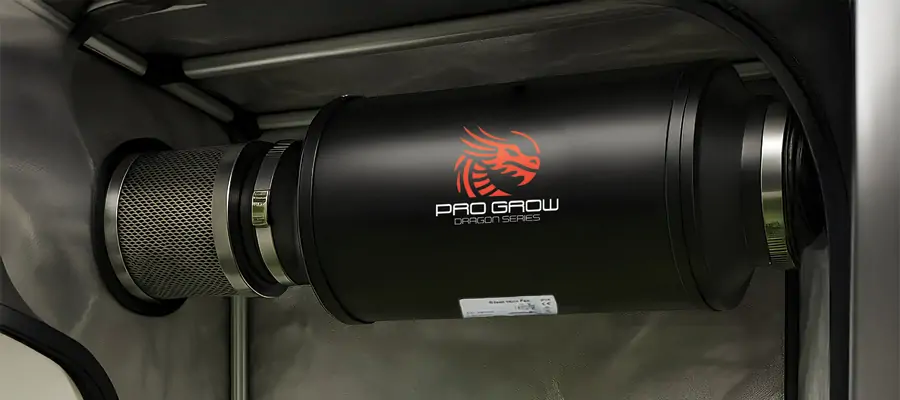
In a grow room context, a loud fan noise often signals that the system is working harder than it should, that the installation has problems, or that the equipment is not matched to the space. Noise and inefficiency tend to travel together. Addressing one usually improves the other.
The challenge with exhaust fan noise reduction is that the most obvious solution, turning the fan down, directly reduces airflow. In a grow room where airflow manages temperature, humidity, CO2 replenishment, and odour control, compromising it to reduce noise is not a trade-off most growers want to make. This guide covers the specific sources of exhaust fan noise in grow room setups, the equipment and techniques that address each source, and how to build a quiet exhaust solution that maintains the airflow your plants require.
Short Summary: Reducing Grow Room Exhaust Fan Noise
- Identify whether the noise comes from the fan motor, airflow turbulence, or structural vibration before choosing a solution.
- Upgrade to a properly sized EC inline fan for quieter, more efficient operation than oversized AC fans.
- Install acoustic ducting and anti-vibration hangers to minimise sound transmission and vibration.
- Use a fan speed controller to match airflow to your grow room's needs while reducing unnecessary noise.
- Position the carbon filter on the fan inlet to help smooth airflow and reduce turbulence noise.
- Combining the right fan, acoustic ducting, vibration isolation, and speed control delivers a quieter ventilation system without compromising airflow.
Where Grow Room Exhaust Fan Noise Comes From
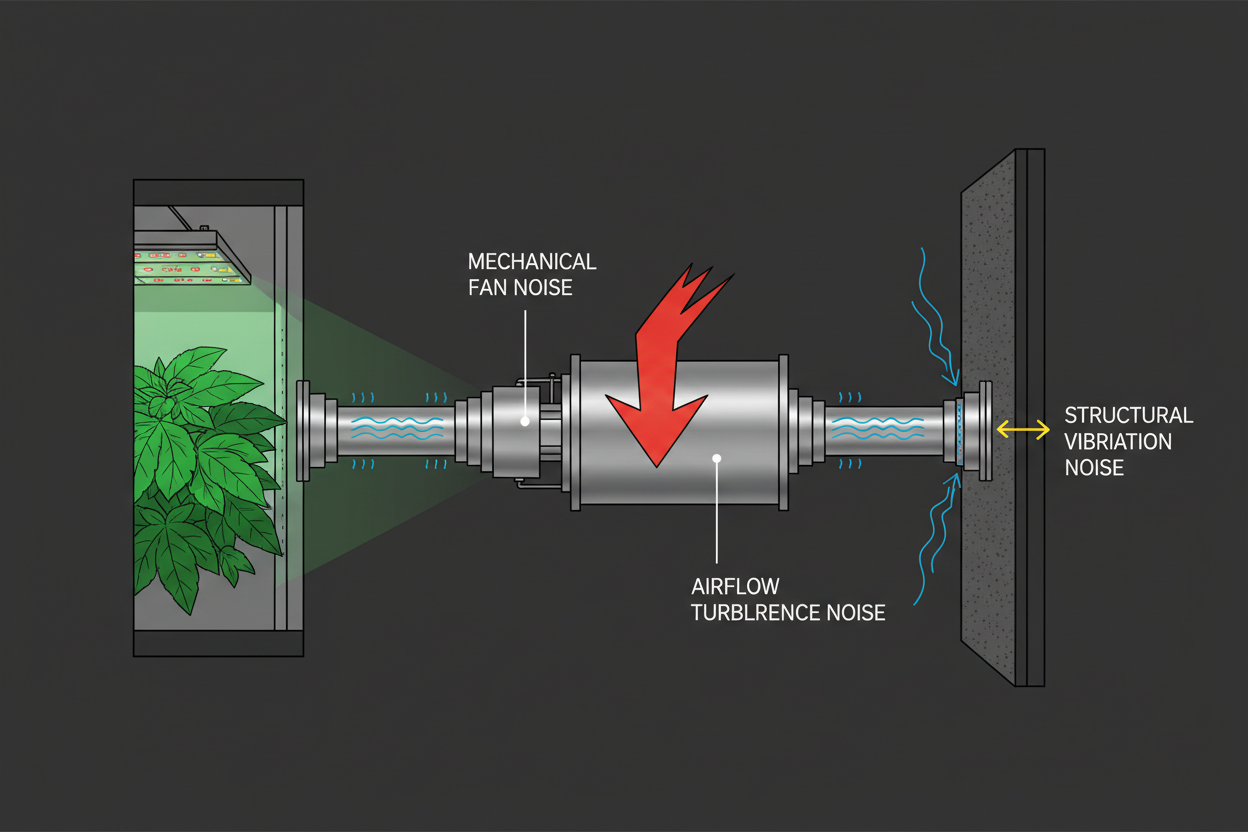
Before reaching for acoustic ducting or a fan controller, it helps to identify which part of the system is generating the noise. Grow room exhaust noise has three distinct sources, and the fix for each is different. Diagnosing the primary source in your setup determines which solution to apply first and prevents spending money on treatments that address the wrong problem.
Mechanical Fan Noise
Mechanical fan noise is generated by the fan motor and impeller itself. Every fan produces some level of mechanical noise from the motor's operation and the movement of air through the housing. The volume depends on the fan's design, build quality, motor type, and how hard it is working relative to its rated capacity. A fan operating near its design point produces less mechanical noise than one that is either oversized and throttled back or undersized and running at full capacity to compensate.
Airflow Turbulence Noise
Airflow turbulence noise is generated when air moves through restrictions, sharp bends, constrictions, or oversized fans running at reduced speed. It presents as a rushing, whooshing sound that changes with fan speed and is more pronounced in systems with long duct runs, multiple bends, or diameter transitions. This type of noise is often mistaken for mechanical motor noise but responds to different treatments, smoothing the duct path and matching the fan size to the system reduces turbulence noise where motor replacement alone would not.
Structural Vibration Noise
Structural vibration noise occurs when the fan's mechanical vibration transfers through the mounting point into the structure of the grow tent, room, or ceiling. The fan itself may be relatively quiet in isolation, but when it couples with a tent frame or ceiling joist, the structure acts as a resonance body that amplifies and transmits the vibration into the surrounding space. This is the noise that is felt as much as heard, a low-frequency thrum that travels through walls and floors into adjacent rooms. Isolation rather than acoustic treatment is the correct response to structural vibration.
Fan Selection
The most effective noise reduction happens at the equipment selection stage. A fan that is correctly sized for the space and duct system, with a motor designed for quiet operation, produces less noise than an oversized fan running at reduced speed or a budget unit whose motor produces significant mechanical noise at any speed. Selecting the right fan from the outset eliminates the most common source of grow room noise before it enters the system.
EC Motor Fans vs AC Motor Fans
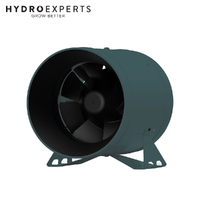
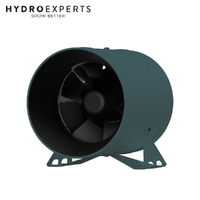
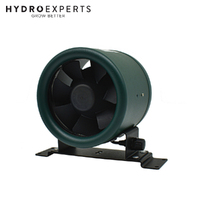
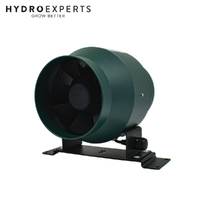
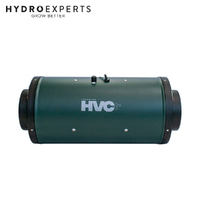
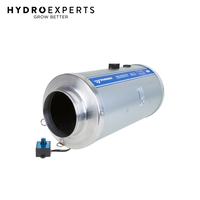
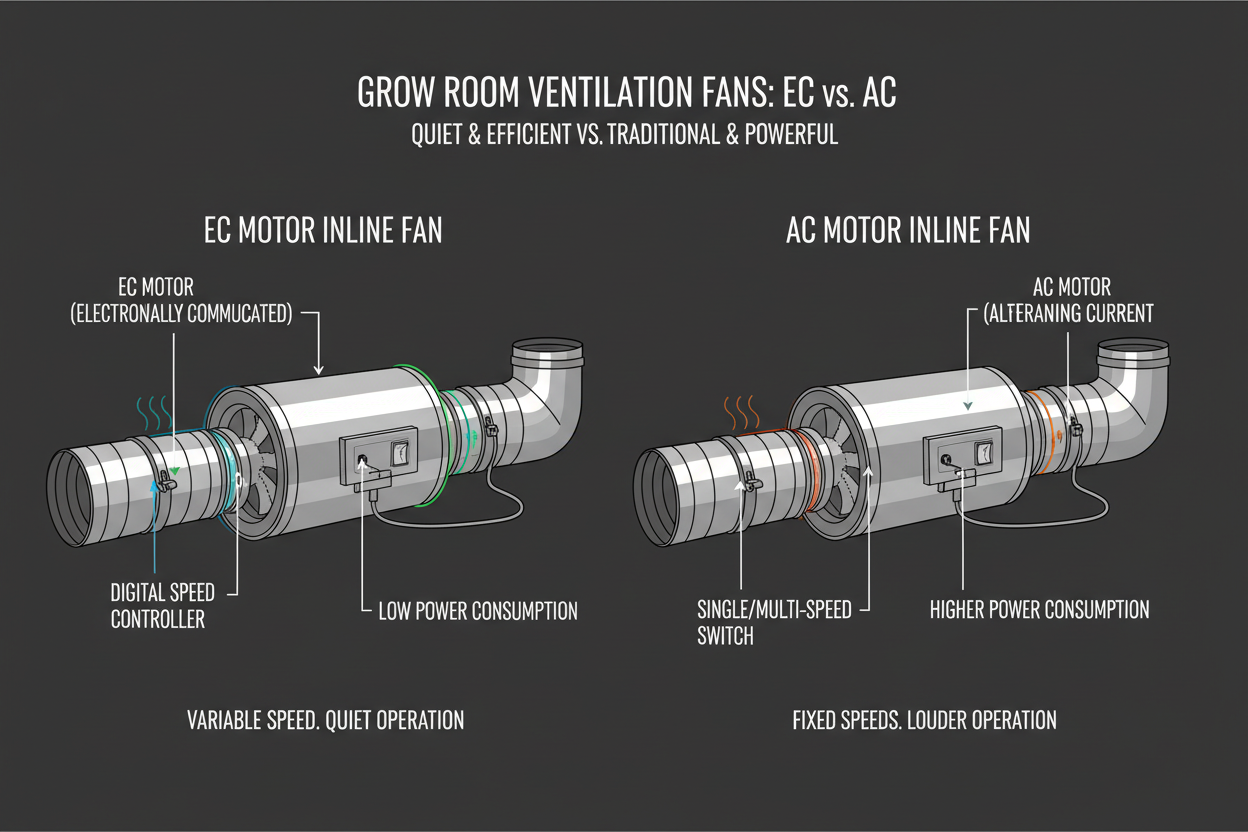
EC (electronically commutated) motor fans are significantly quieter than traditional AC motor fans, particularly at reduced speeds. The motor design produces less vibration, less heat, and a smoother power delivery that translates directly to quieter operation. When an EC fan is dialled back to 60 or 70% of its rated speed to match the airflow requirement of a space, it operates with substantially less noise than an equivalent AC fan at the same speed setting. AC fans that are oversized for their duct system and run at reduced speed through a controller are a common source of grow room noise; the fan is sized for a larger system, and when throttled back, airflow turbulence through the fan housing increases. Replacing an oversized AC fan with a correctly sized EC inline fan consistently produces the largest single noise reduction of any change in the system.
Axial Fans vs Mixed Flow Fans vs Centrifugal Fans
Beyond motor type, the blade and housing design of the fan itself has a direct impact on how much noise it generates once it's connected to real-world ducting, filtration, and bends. The three main fan types used in grow room ventilation each behave differently under load, and picking the wrong one for your setup is a common, avoidable source of noise.
Axial Fans
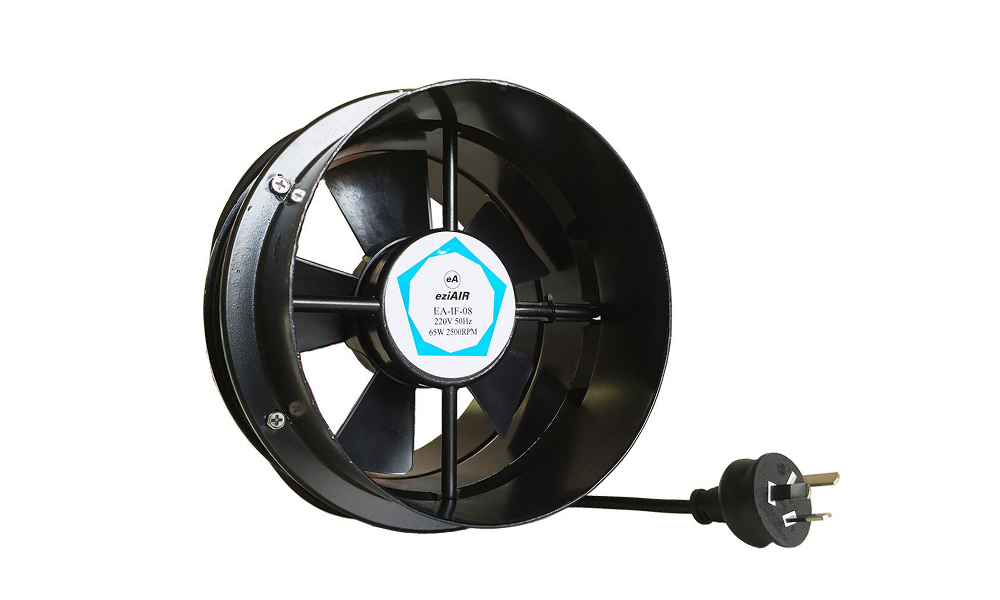
These types of fans move air in a straight line parallel to the motor shaft, using a propeller-style blade design. They're capable of high airflow volume in open, unrestricted conditions, but they lose performance quickly once static pressure is added to the system, from ducting, bends, or a carbon filter. As resistance increases, an axial fan has to work harder to maintain airflow, and this is exactly where turbulence noise builds. In a grow room running any meaningful length of ducting or a filter, an axial fan is usually the noisiest option for the airflow it actually delivers under real conditions.
Mixed Flow Fans
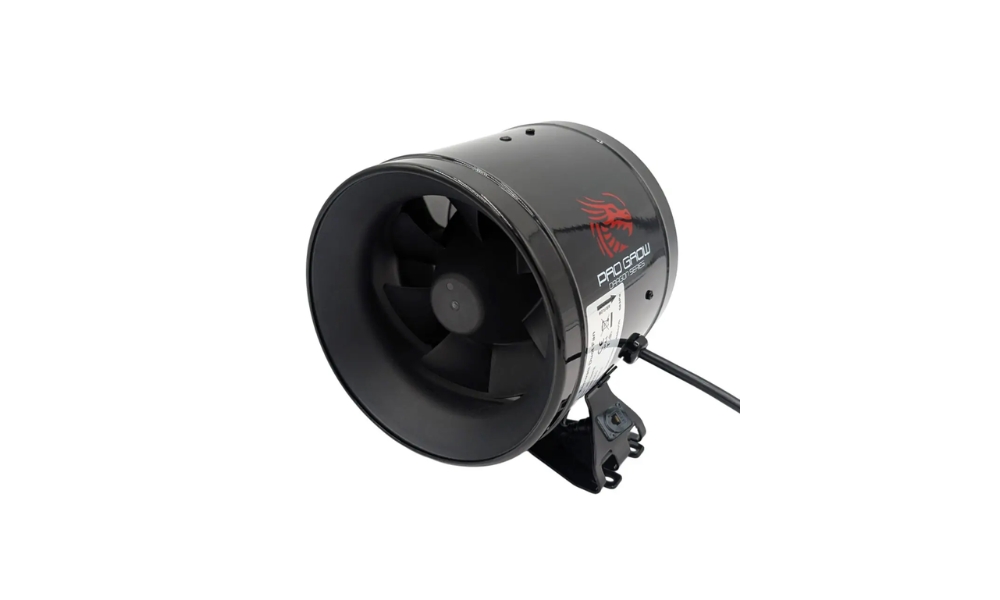
These fans combine characteristics of both axial and centrifugal designs, using an angled blade profile that pushes air both forward and outward as it passes through the housing. This gives mixed flow fans meaningfully better static pressure performance than axial fans, while still maintaining strong airflow and compact, inline-friendly housing. This balance is why mixed flow design has become the standard choice for quality inline grow room fans, since it holds up well against the resistance of ducting and carbon filtration without the sharp noise increase an axial fan experiences under the same load.
Centrifugal Fans
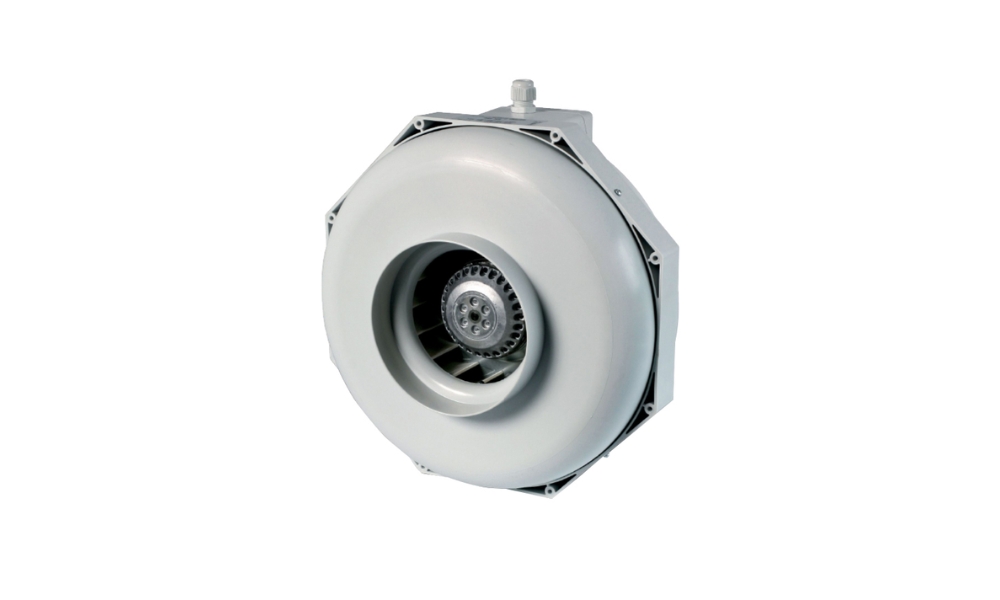
They are also called radial or blower fans, draw air in along the shaft and expel it outward through a rotating impeller, generating significantly higher static pressure than either axial or mixed flow designs. This makes them well suited to systems with long duct runs, dense carbon filtration, or multiple bends where airflow resistance is genuinely high. Centrifugal fans can be bulkier and, depending on the specific design and motor, louder than a mixed flow unit at equivalent airflow, so they tend to make the most sense for larger or more demanding setups rather than a standard single-tent grow room.
For most grow tent and grow room setups running a standard carbon filter and moderate duct length, a mixed flow EC fan offers the best balance of quiet operation and reliable static pressure performance. Axial fans suit only the simplest, most unrestricted airflow setups, and centrifugal fans are worth stepping up to specifically when duct length or filtration density genuinely demands the extra static pressure.
Acoustic Ducting: The Most Targeted Noise Reduction Tool
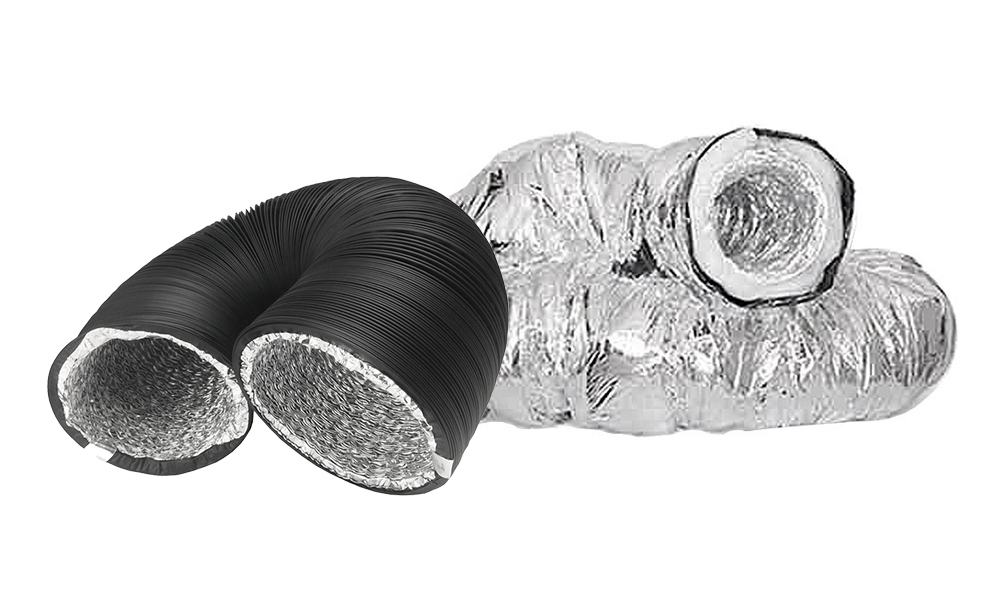
Standard flexible ducting transmits the noise generated by fans and airflow turbulence along its length and radiates sound through its walls into the surrounding space. Acoustic ducting adds sound-absorbing insulation to the duct wall construction, reducing both the transmission and radiation of sound. In situations where the duct runs through or adjacent to living spaces, bedrooms, or areas where grow room noise creates problems with neighbours or housemates, acoustic ducting on the exhaust run is one of the most targeted and effective fixes available.
How Acoustic Ducting Works
Standard flexible duct consists of a wire-supported inner liner with a thin foil or polyester outer layer. Sound generated inside the duct passes through the thin wall with minimal resistance. Acoustic ducting adds a layer of acoustic foam or mineral wool insulation between the inner liner and an outer casing, absorbing the sound energy before it can radiate through the duct wall. The practical noise reduction from switching to acoustic ducting on the primary fan output run varies depending on the fan and system but is consistently audible.
Acoustic ducting is heavier and less flexible than standard duct, which means it needs adequate support along its run and does not navigate tight bends as easily. Plan the duct route before installing and use proper duct hangers or brackets to support the additional weight for best results.
Vibration Isolation
A fan that is bolted or strapped directly to a tent frame, ceiling joist, or wall transfers its mechanical vibration directly into the structure. The structure then acts as a resonance amplifier, transmitting the vibration as audible sound into the surrounding room or adjacent spaces. The fan itself may be relatively quiet in isolation, but once coupled to a rigid structure the overall noise level increases significantly. Vibration isolation is the fix for this specific noise path and it is independent of the fan's own noise output.
Silicone Hangers and Anti-Vibration Mounts
The most effective vibration isolation solution for inline fans is to hang the fan on silicone or rubber bungee-style hangers rather than rigid brackets. Silicone hangers absorb the motor's vibration before it can transfer to the mounting point. A fan suspended on four silicone hangers from a tent crossbar or ceiling beam produces measurably less structural noise than the same fan clamped directly to the structure. Anti-vibration hangers are low-cost, easy to install, and one of the highest-return investments in any noise reduction effort.
Flexible Duct Connections
Rigid connections between the fan and the duct allow vibration to travel from the fan housing into the duct run and from there into the mounting structure at the other end of the duct. Using short sections of flexible ducting as a transition between the fan and any rigid duct components creates a vibration break that prevents this transmission path. Even in fully flexible duct systems, a loose loop of duct near the fan rather than a taut direct connection provides a degree of vibration decoupling that reduces the transfer of motor vibration into the duct and tent structure.
Fan Speed Controllers: Running Fans at the Right Speed
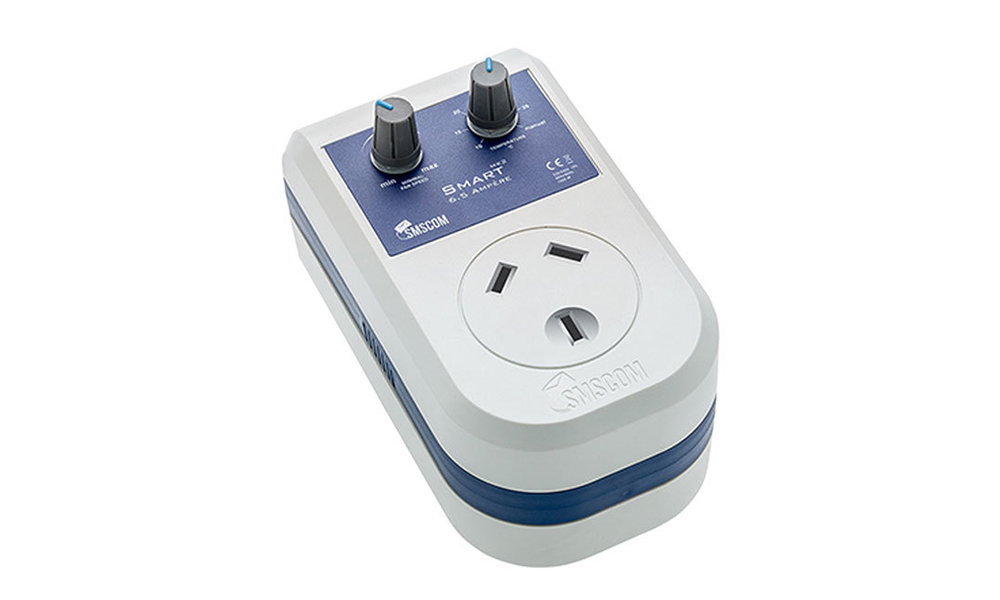
An oversized fan running at full speed is louder than a correctly sized fan running at its design point. Fan speed controllers allow the output of a fan to be reduced to match the actual ventilation requirement of the space rather than running at maximum capacity regardless of conditions.
The relationship between fan speed and noise is not linear, reducing a fan to 70 or 80 percent of its maximum speed produces a noise reduction that is proportionally greater than the airflow reduction, particularly for EC fans where the motor efficiency and noise characteristics at reduced speeds are significantly better than at full output.
The caveat is that not all fans respond equally to speed control. Some AC fans produce more turbulence noise at reduced speeds than at full speed due to the mismatch between the fan's aerodynamic design and the reduced airflow conditions. EC fans are designed to run efficiently across a wide speed range and respond to speed control without the turbulence penalty that some AC fans exhibit.
A temperature and humidity controller that automatically adjusts fan speed in response to environmental conditions rather than running at a fixed setting provides noise reduction during periods when the full ventilation capacity is not needed, which in most grow rooms is a significant portion of the operating day.
Acoustic Silencer, Inline Duct Muffler and Carbon Filter Positioning
Acoustic Silencer and Inline Duct Muffler
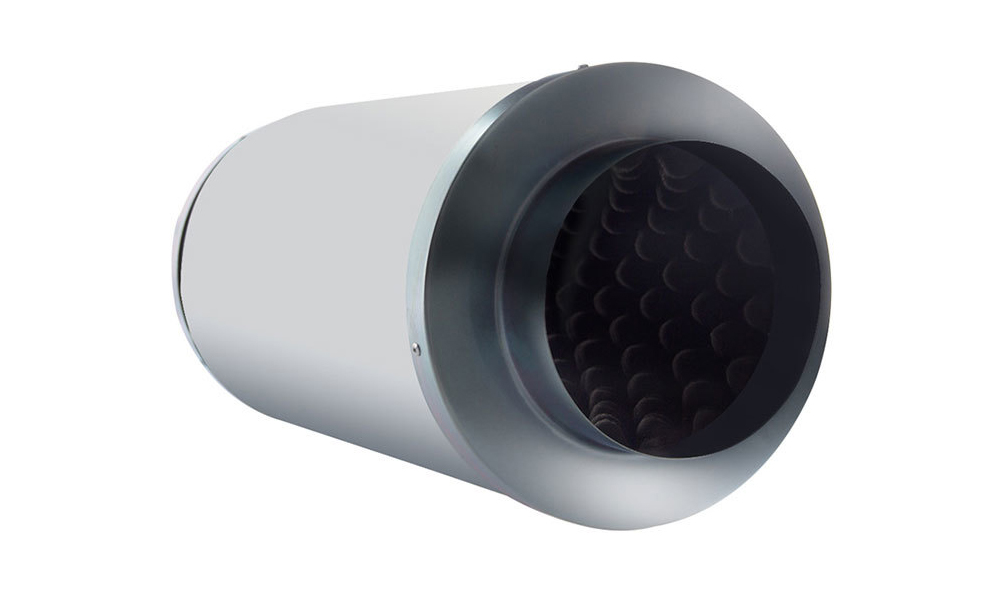
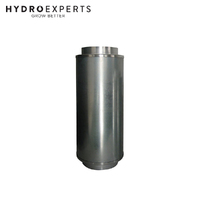
An acoustic silencer, sometimes called an inline duct muffler, is a duct-mounted section fitted internally with sound-absorbing baffles or acoustic lining. Rather than housing the fan itself, it's installed directly in the duct run, and air passes straight through it while the internal lining absorbs mechanical and airflow noise traveling along the ductwork. This makes it a genuinely useful addition anywhere along the duct path, not just at the fan itself, and it's particularly effective when placed close to the fan outlet, where noise levels in the ducting are typically at their highest.
Carbon Filter Positioning
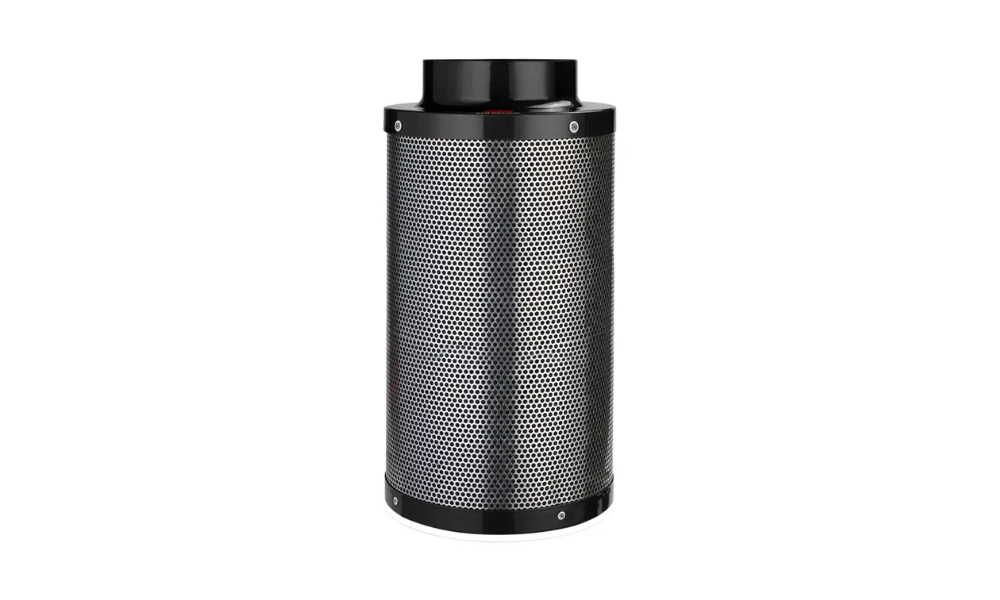
The carbon filter in an exhaust system serves a dual function in noise management. When positioned on the intake side of the fan, the filter provides resistance before the air reaches the fan, which reduces the turbulence noise generated by the fan operating in free-air conditions. Carbon filters also add mass to the system that helps dampen vibration transmission. Positioning the filter on the fan inlet rather than the outlet is the standard configuration for both odour control and noise management purposes; it smooths the airflow entering the fan impeller and reduces the turbulence that generates rushing noise inside the fan housing.
Building a Quiet Exhaust System
The most effective quiet exhaust fan solution combines multiple approaches rather than relying on any single fix. A correctly sized, mixed flow or centrifugal EC motor inline fan, suspended on silicone anti-vibration hangers, connected to the duct run through flexible transition sections, ducted through acoustic ducting on the primary run, fitted with an inline duct muffler where extra noise treatment is needed, and speed-controlled to match the actual ventilation requirement of the space, produces dramatically less noise than a standard setup while maintaining the airflow the grow room needs.
Each element addresses a different noise source:
- Fan selection, including choosing the right fan type for your static pressure needs, reduces mechanical and turbulence noise at the source.
- Vibration isolation stops structural transmission.
- Acoustic ducting and inline duct mufflers reduce radiated airflow noise along the duct run.
- Speed control matches the fan's output to the actual requirement.
Together, they produce a system that is audibly quieter at every point in the signal chain.
| Noise Source | Solution | Expected Impact |
|---|---|---|
| Mechanical motor noise | EC inline fan, correctly sized | High: addresses noise at the source |
| Airflow turbulence | Acoustic ducting, smooth duct routing | High: reduces radiated duct noise |
| Structural vibration | Silicone anti-vibration hangers, flexible duct transitions | High: breaks vibration transmission path |
| Fan running above required capacity | Fan speed controller or environmental controller | Moderate-High: reduces all noise types proportionally |
| Intake turbulence at fan | Carbon filter on fan inlet | Moderate: smooths airflow entering the impeller |
A correctly sized EC motor inline fan, suspended on silicone anti-vibration hangers, connected through flexible duct transitions, ducted through acoustic ducting on the primary run, and speed-controlled to match actual ventilation requirements, produces dramatically less noise than a standard setup, while maintaining the airflow your grow room needs.
Quiet Ventilation Solutions at Vent Experts
Hydro Experts stocks the full range of components for quiet exhaust fan solutions, including EC inline fans, acoustic ducting, anti-vibration hangers, fan speed controllers, and carbon filters for growers building a new setup or troubleshooting an existing noisy system. Visit our website today for the full picture and get the right equipment matched to your space.
FAQs
Inline fan noise at low speed is usually caused by one of three things: the fan is oversized for the duct system and airflow turbulence increases when it is throttled back; the fan motor is an AC type that does not run efficiently at reduced speeds; or the fan is coupled to the structure through rigid mounting that amplifies vibration. Diagnosing which of these applies, turbulence noise, motor noise, or structural resonance, determines the correct fix. An EC fan upgrade combined with silicone hangers addresses all three causes simultaneously.
Yes, particularly for airflow turbulence noise that radiates through standard duct walls into adjacent spaces. Acoustic ducting adds a layer of sound-absorbing insulation between the inner liner and outer casing that absorbs sound energy before it can radiate. The reduction is consistently audible in most grow room installations, and is most noticeable when the duct run passes through or near living areas. It is most effective when combined with a correctly sized fan and vibration isolation rather than used as a standalone fix for an otherwise poorly configured system.
Reducing fan speed reduces both noise and airflow, so the key is running the fan at the lowest speed that still meets the ventilation requirement of the space rather than running at maximum capacity unnecessarily. In most grow rooms, the full ventilation capacity is not needed continuously — a temperature and humidity controller that adjusts fan speed automatically in response to environmental conditions achieves noise reduction during low-demand periods while maintaining full airflow when conditions require it. EC fans handle this variable speed operation more efficiently and quietly than AC fans.
Silicone or rubber anti-vibration hangers that suspend the fan from the mounting point rather than clamping it rigidly are the most effective solution. The silicone absorbs the motor's vibration before it transfers to the structure. Short sections of flexible ducting used as transitions between the fan and any rigid duct components provide an additional vibration break, preventing vibration from travelling along the duct into the tent frame or ceiling at the other end of the run. Together, these two measures address both the primary and secondary vibration transmission paths.
Yes, indirectly. A carbon filter positioned on the fan inlet reduces the turbulence noise generated by the fan operating with unrestricted intake airflow. The filter adds resistance before the air reaches the fan impeller, smoothing the airflow and reducing the turbulence that creates rushing noise inside the fan housing. This is one reason why inlet positioning is the standard configuration for carbon filters in exhaust systems — it benefits both odour control and noise management compared to placing the filter on the outlet side.