



Phresh Hyperfan v2 150mm Review : Is It Worth the Upgrade From a Standard AC Fan
By Hydro Experts | 5 August 2026
The Phresh Hyperfan EC Fan v2 150mm combines 560 m³/h airflow with high static pressure, EC efficiency, and variable speed control. This review explains how it performs in real grow room ventilation setups and what to pair it with.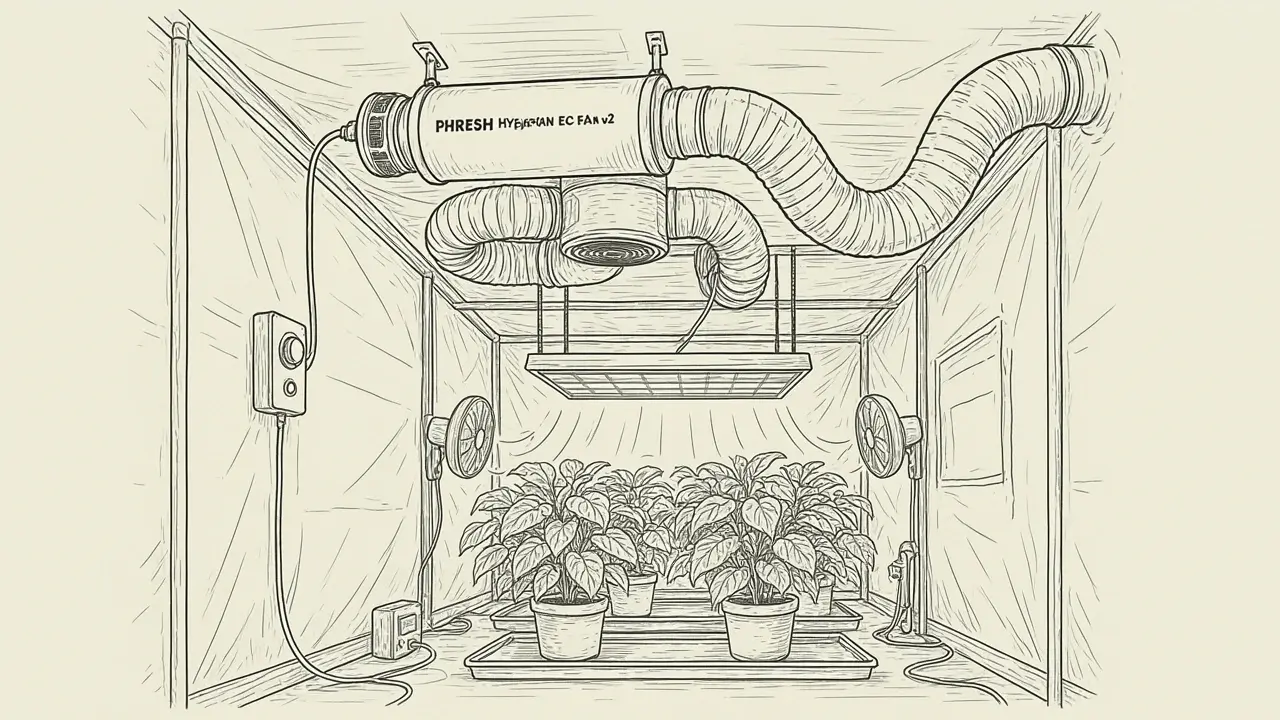
Every serious grow room eventually runs into the same bottleneck: the exhaust fan either is not moving enough air, or it is loud enough that running it around the clock becomes its own problem. The Phresh Hyperfan EC Fan v2 was built specifically to solve both issues at once, and after digging into the full spec sheet, it is worth understanding exactly what makes this fan different from a standard AC inline fan beyond the marketing claims.
This review covers what the Hyperfan v2 150mm actually does differently, how it stacks up against other EC fans on the market, and what to pair it with for the best results in your setup.
Quick Summary: Phresh Hyperfan EC Fan v2 Review
- The Phresh Hyperfan v2 150mm delivers up to 560 m³/h (330 CFM) of airflow.
- Its 545Pa static pressure is a major advantage for systems using carbon filters and ducting.
- The EC motor provides smooth variable speed control and better efficiency than traditional AC fans.
- A detachable speed controller is included, with 0–10V controller compatibility for automation.
- Properly sized 150mm ducting and a compatible carbon filter help maximise performance.
- It is best suited to growers running filtered and ducted ventilation who need reliable airflow under resistance.
What Makes the Hyperfan v2 Different
The Hyperfan is built around what Phresh calls "aircraft taper blade technology," a laminar blade design intended to optimise how air moves across the fan blade rather than simply pushing volume through brute force. Combined with a 9-pole digital EC brushless motor, the result is a fan designed around efficiency and airflow quality, not just raw CFM numbers.
Key Specifications at a Glance
- Size: 150mm (6 inch)
- Max airflow: 560 m³/h, 330 CFM, 156 LPS
- Static pressure: 545Pa, one of the highest ratings in this fan class
- Noise level: 66 dBA
- Efficiency: 7.85 CFM per watt
- RPM: 5000
- Current draw: 0.3A
- Weight: 1.9kg
- Housing: Stainless steel
- Bearings: ABEC 7 ball bearings
- Controller: Detachable, fully variable-speed controller included; 0-10V compatible via RJ9 or RJ11 cable
Priced at $263.46 (discounted from $309.95) and currently in stock, this fan includes its own dedicated speed controller in the box. That matters more than it might seem at first glance, since many competing fans at this price point sell the controller separately.
Why Static Pressure Is the Number That Matters
Most people shopping for an exhaust fan focus almost entirely on CFM, the raw volume of air a fan can move. CFM alone does not tell you how a fan will actually perform once it is connected to ducting, a carbon filter, and any bends or restrictions along the way.
Static pressure is the number that tells you how well a fan can keep pushing air against that resistance. The Hyperfan's 545Pa rating is genuinely high for a fan in this size class, which means it holds onto more of its rated airflow even while working against a carbon filter and a run of ducting, rather than dropping off sharply the moment any resistance is added to the system.
This is the practical difference between a fan that looks good on paper and one that actually performs once it is installed in a real grow room with filtration and ducting attached. For any filtered, ducted setup, static pressure is the spec worth prioritising over headline CFM figures.
The Benefits of Switching to an EC Fan
If you are currently running a standard AC inline fan, moving to an EC fan like the Hyperfan produces a few noticeable changes to how your ventilation system actually behaves day to day.
Genuine Variable Speed Control
EC motors allow smooth, precise speed adjustment across the full operating range, letting you dial in exactly the airflow your space needs rather than choosing between a few fixed settings. This is a meaningful difference from the stepped speed controls common on cheaper AC fans, where your options are limited to a handful of preset levels rather than continuous adjustment.
Better Energy Efficiency
At 7.85 CFM per watt, the Hyperfan draws meaningfully less power than a comparable AC fan pushing similar airflow. That efficiency gap adds up over months of continuous operation across a full grow cycle, particularly relevant for growers running exhaust around the clock.
Quieter Operation Across the Speed Range
Because EC fans can run efficiently across their full speed range rather than being built around a single fixed operating point, you can run the fan quieter for day-to-day ventilation and ramp up only when maximum extraction is genuinely needed. The 66 dBA rating applies at full speed; everyday operating speeds sit considerably below that peak.
Smart Controller Compatibility
The 0-10V control input means this fan can be integrated into automated grow room controllers, adjusting speed automatically based on temperature or humidity readings rather than requiring manual adjustment. For growers building a more automated setup, this compatibility is a significant practical advantage over AC fans that offer no equivalent integration pathway.
How the Hyperfan Compares to Other EC Fans
The differences between 150mm EC fans are not always obvious from spec sheets alone. Here is how the Hyperfan stacks up against comparable options in the same category.
| Fan | Airflow | Static Pressure | Key Consideration |
|---|---|---|---|
| Phresh Hyperfan v2 150mm | 560 m³/h / 330 CFM | 545Pa | Highest static pressure in class; holds airflow well under filter and duct resistance |
| AC Infinity Cloudline Pro T6 | 402 CFM | Lower than Hyperfan | Higher headline CFM but the Hyperfan's static pressure advantage means stronger real-world performance in filtered setups |
| Pro Grow Dragon Aeroblast 150mm | 282 CFM | Not specified | Sits below the Hyperfan on airflow; less suitable for longer duct runs or denser carbon filters |
| Headwind HVC Mixed Flow 150mm | 594 m³/h | Closely matched | Comparable raw airflow; deciding factors are noise level, build quality, and controller integration |
For growers who have been disappointed by a fan that performs well in an open-air test but underdelivers once connected to a filter and ducting, the Hyperfan's static pressure rating is the number worth paying closest attention to in this comparison.
What the Difference Actually Looks Like in Your Grow Space
The specs translate to real grow room conditions in a few specific ways.
- More consistent air exchange, since the fan maintains stronger performance even as resistance builds from ducting and filtration, rather than losing effectiveness the moment a filter is attached.
- Lower running costs over time, particularly relevant for growers running exhaust continuously across a full grow cycle given the fan's efficiency rating compared to a standard AC unit.
- Better temperature and humidity control, since precise variable speed means you can fine-tune extraction rather than cycling a fixed-speed fan on and off, which tends to create less stable environmental conditions.
- A genuinely quieter grow space at everyday operating speeds, which matters considerably if your setup is anywhere near living spaces.
Products to Combine With the Hyperfan for Best Results
An exhaust fan rarely performs at its best in isolation. The following pairings work well with the Hyperfan and make the most of its static pressure and airflow capability.
Insulated Acoustic Ducting (152mm)
A 152mm insulated acoustic duct reduces noise transfer along the duct run while also improving thermal performance. This pairing makes the most of the Hyperfan's already quiet operation by addressing the secondary noise source that standard flexible ducting introduces into the system.
A Quality Carbon Filter Matched to 150mm Ducting
The Hyperfan's static pressure advantage is most useful when it is actually working against a properly sized carbon filter. Pairing it with a filter matched to the 150mm inlet size ensures the fan's real-world performance advantage over lower static pressure fans becomes visible, rather than pairing it with an undersized fan that would struggle under the same load.
A Multi-Fan EC Controller
If you are running more than one EC fan and want centralised control across your whole setup, a dedicated multi-fan controller such as the GAS EC5 Fan Speed Controller allows you to manage all fans from a single interface rather than adjusting each fan's included controller individually.
Getting the ducting and filtration sized correctly around the Hyperfan is what determines whether you see its full performance advantage. A bottleneck anywhere in the duct run undermines even a high static pressure fan, so the fan and the surrounding system need to be matched to each other to see the results the specs promise.
Who Should Buy the Hyperfan v2
This fan makes the most sense for growers who meet one or more of the following conditions.
- Running a filtered, ducted exhaust setup rather than simple open-air ventilation, where the static pressure advantage is actually put to use.
- Wanting genuine variable speed control rather than the stepped settings of a standard AC fan.
- Looking to integrate ventilation into a broader automated grow room controller via the 0-10V input.
- Prioritising quieter day-to-day operation, particularly in spaces where noise is a genuine consideration.
Upgrade Your Grow Room Ventilation with the Phresh Hyperfan v2
Ready to upgrade your grow room ventilation? Check current pricing and availability for the Phresh Hyperfan EC Fan v2 150mm at Hydro Experts, or reach out to the team for help pairing it with the right ducting and carbon filtration for your setup.
FAQs
CFM measures the raw volume of air the fan can move in open-air conditions, while static pressure measures how well the fan maintains that airflow against resistance from ducting and filtration. The Hyperfan's 545Pa static pressure rating is what allows it to perform well once connected to a carbon filter, rather than losing significant airflow the moment resistance is added to the system. In a filtered, ducted grow room, static pressure is the more useful number to compare between fans.
Yes. A detachable, fully variable speed controller is included in the box. The fan also supports 0-10V control via RJ9 or RJ11 cable for integration with automated grow room controllers, which means the included controller is a genuine starting point rather than a placeholder that needs immediate replacement for anyone wanting more precise environmental automation.
It is rated at 66 dBA at maximum output. Like most EC fans, running it at lower speeds for everyday ventilation reduces noise considerably below that peak rating. The practical advantage of an EC fan over a fixed-speed AC fan is that you can dial the Hyperfan down to whatever speed your space actually requires for day-to-day air exchange, rather than running it flat out continuously.
Properly sized 150mm ducting is the starting point, ideally insulated acoustic ducting to minimise noise transfer along the duct run. A carbon filter matched to the same duct size completes the core setup, since the fan's static pressure advantage is most visible once it is working against the resistance of a filter rather than in open-air conditions. Avoid undersized ducting anywhere in the run, since any bottleneck in the system undermines the fan's static pressure capability regardless of its rated figures.
For most filtered, ducted setups, yes. The combination of higher static pressure, genuine variable speed control, and better energy efficiency makes it a meaningful upgrade over a typical AC fan, particularly for growers running exhaust continuously through a full grow cycle. The efficiency gain alone produces savings over time, and the static pressure advantage means the fan maintains stronger real-world performance than headline CFM comparisons between AC and EC fans would suggest.