

How to Maximize Hydroponic Yield with Smart Scheduling 2026
By Hydro Experts | 29 April 2026
Hydroponic yield optimization starts with smart scheduling. Master nutrient timing, light cycles, and growth stage scheduling for bigger, better harvests.
The difference between a hydroponic grower who achieves good results and one who achieves excellent results often comes down to scheduling. The inputs are largely the same: nutrients, light, water, and a controlled environment. What separates high-yield grows from average ones is the precision and timing with which those inputs are delivered across each stage of plant development.
Smart scheduling in hydroponics means matching what you give the plant to what the plant actually needs at each point in its growth cycle. This guide covers nutrient timing, light cycle management, and growth stage-specific strategies that translate directly into higher output from any hydroponic setup.
Understanding Growth Stages Before Scheduling Anything
Effective scheduling begins with a clear map of the plant's growth stages and what each one requires. Applying a single feeding and lighting approach across the full growth cycle is one of the most common yield-limiting mistakes in hydroponic growing.
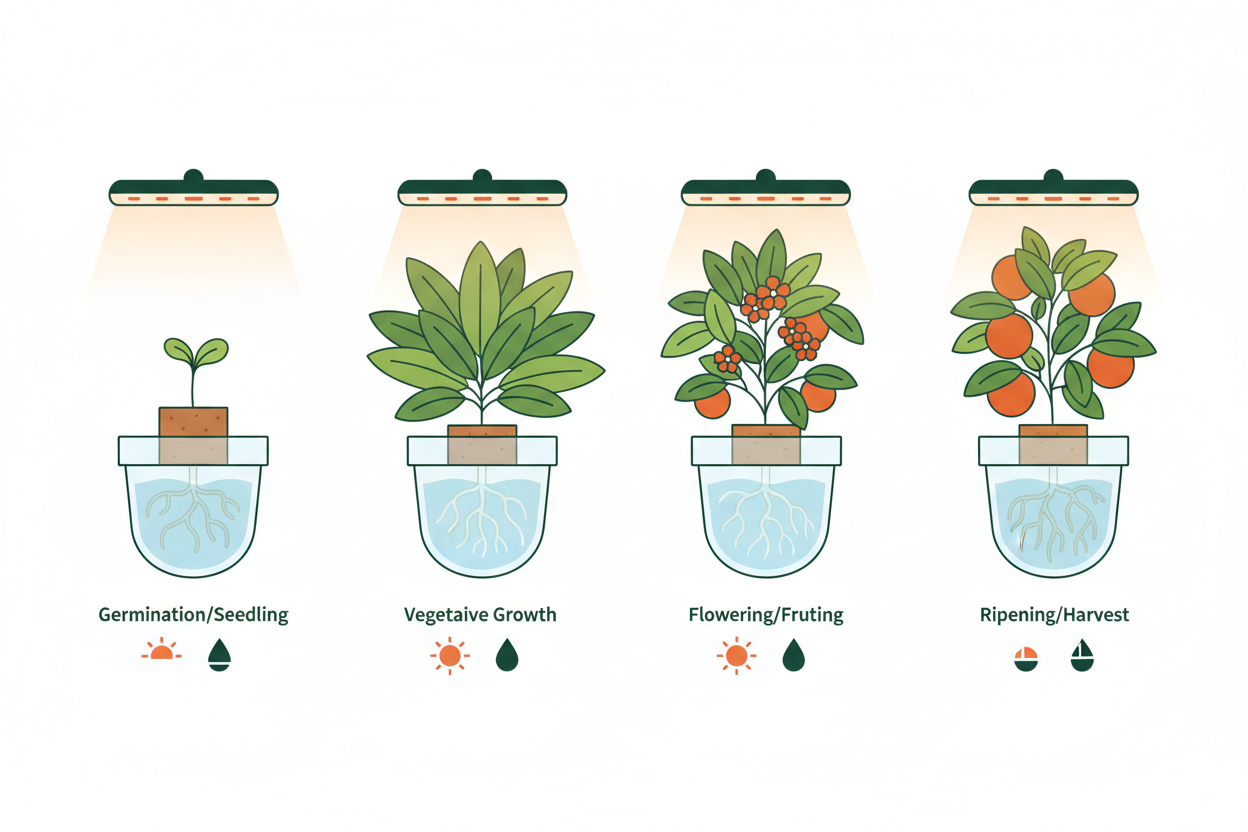
Most crops move through four distinct phases: germination and seedling, vegetative growth, flowering or fruiting, and the pre-harvest or ripening stage. Each phase has different requirements for light intensity, photoperiod, nutrient concentration, and the ratio of key elements. A schedule built around these phases rather than a uniform daily routine produces measurably better results.
The transition points between phases are where scheduling decisions have the most impact. Misreading when a plant is ready to move from vegetative to flowering, or continuing a vegetative feeding profile into the flowering stage, costs yield in a way that cannot be recovered later in the cycle.
Stage-by-Stage Scheduling: Nutrients and Light
Germination and Seedling Stage
The seedling stage is where the foundation of the plant's root system and early structure is established. Overfeeding at this stage is more damaging than underfeeding. Young roots are sensitive, and high EC levels in the nutrient solution can cause root burn that sets back development significantly.
Target EC during the seedling stage is 0.8 to 1.2 mS/cm. The nutrient solution should be light and well-balanced with a slight emphasis on phosphorus to support root development. Some growers use a dedicated seedling or cloning nutrient formula during this phase rather than a diluted version of their vegetative base nutrient.
Lighting during the seedling stage should be on the lower intensity end of the grow light's range, positioned further from the canopy than during vegetative growth. An 18/6 photoperiod, 18 hours of light and 6 hours of darkness, suits most non-photoperiod crops through the seedling stage. The seedling stage runs until the plant has developed its first true leaves and a visible root structure. Rushing this transition by increasing nutrients too early produces spindly, under-rooted plants that never reach their yield potential.
Vegetative Stage: Building the Structure That Holds Yield
Vegetative growth is where the plant builds the physical structure that will carry its yield. Leaf mass, stem strength, branching architecture, and root density all develop during this phase. A plant that is underdeveloped at the end of the vegetative stage cannot produce its maximum yield regardless of how well the flowering stage is managed.
Nutrient scheduling during vegetative growth emphasises nitrogen as the primary driver of leaf and stem development. A vegetative base nutrient with a high nitrogen ratio is the foundation. EC during vegetative growth runs between 1.4 and 2.0 mS/cm for most crops, increasing gradually as the plant develops and its uptake capacity increases. Calcium and magnesium requirements increase substantially during this phase, making a dedicated Cal-Mag supplement an important addition to prevent interveinal chlorosis and tip burn.
Light scheduling during vegetative growth uses an 18/6 photoperiod for most crops. Light intensity should sit between 400 and 600 micromoles per square metre per second at canopy level. Training techniques including low stress training, topping, and screen of green methods are most effective when applied early in the vegetative stage, improving light penetration and increasing the number of productive flowering sites before the transition to flowering.
Reservoir management during vegetative growth should include top-up with fresh nutrient solution daily to replace water uptake, with a full reservoir change every seven to ten days to prevent nutrient drift and salt accumulation.
The Transition to Flowering: Getting the Timing Right
The transition from vegetative to flowering is the most consequential scheduling decision in the growth cycle. Moving too early produces underdeveloped plants with insufficient structural capacity to support maximum yield. Moving too late in photoperiod-sensitive crops delays flowering and extends the cycle without proportionate yield benefit.
For photoperiod-sensitive crops, the flowering transition is triggered by shifting the light cycle from 18/6 to 12/12, 12 hours of light and 12 hours of darkness. The darkness period must be uninterrupted. Any light exposure during the dark period disrupts hormonal signalling and can cause hermaphroditism or delayed flowering. Light-proofing the growing space is a scheduling and infrastructure requirement, not just an optional precaution.
For autoflowering crops, the transition to flowering is genetically determined and not triggered by light cycle change. Autoflowering varieties can be run on an 18/6 or 20/4 schedule throughout their entire life cycle, simplifying the light scheduling requirement considerably. The nutrient transition from vegetative to flowering profile should begin at the same time as the light cycle change, reducing nitrogen gradually over the first one to two weeks while increasing phosphorus and potassium to avoid stressing the plant during a critical developmental period.
Flowering Stage: Nutrient and Light Scheduling for Maximum Output
The flowering stage is where yield is determined and where nutrient scheduling has its most direct impact on final output. Phosphorus drives energy transfer, root development in flowering clusters, and the cellular processes that build flower structures. Potassium supports sugar transport, stomatal regulation, and fruit or flower density. A flowering base nutrient with a ratio weighted toward phosphorus and potassium, with reduced nitrogen, is the foundation of the flowering feeding schedule.
EC during the flowering stage typically runs between 1.8 and 2.6 mS/cm for most crops. Monitor EC and pH daily during flowering, pH should be maintained between 5.5 and 6.5 to keep all nutrients available at the root zone. pH drift during flowering is the most common cause of mid-cycle deficiencies that compromise final yield. PK booster supplements providing a concentrated phosphorus and potassium spike during the mid-flowering period are a standard addition to advanced flowering schedules.
Light intensity at canopy level should increase compared to the vegetative stage, with PPFD between 600 and 900 micromoles per square metre per second for most flowering crops. Light uniformity across the canopy ensures that lower and outer flowering sites develop comparably to the primary sites at the top of the canopy.
Pre-Harvest and Ripening Stage
The final two to three weeks before harvest are a distinct phase with their own scheduling requirements. During this period the plant completes the development of its flowers or fruit and begins to consolidate its resources. Continuing the peak flowering feeding schedule through to harvest overloads the plant with nutrients that cannot be fully utilised and leaves residual salts in the plant tissue that affect final product quality.
Introduce a pre-harvest flush or transition to a ripening-specific nutrient during the final two weeks. Reduce overall nutrient concentration and shift the focus to potassium, which supports final density and quality consolidation. Some growers run plain pH-adjusted water for the final seven to ten days, while others use a dedicated flushing agent to accelerate the clearance of residual salts from plant tissue.
A feeding diary that logs EC, pH, reservoir changes, light schedule adjustments, and visual plant observations across each growth stage provides the data to identify what worked and what to adjust in the next cycle. Yield improvements in hydroponics accumulate through incremental adjustments informed by what the previous grow's records reveal.
Growth Stage Quick-Reference Schedule
| Growth Stage | EC Range (mS/cm) | pH Range | Light Schedule | Key Nutrient Focus |
|---|---|---|---|---|
| Seedling | 0.8 – 1.2 | 5.5 – 6.5 | 18/6 | Phosphorus (root development) |
| Vegetative | 1.4 – 2.0 | 5.5 – 6.5 | 18/6 | Nitrogen, Calcium, Magnesium |
| Flowering | 1.8 – 2.6 | 5.5 – 6.5 | 12/12 | Phosphorus, Potassium (PK boost) |
| Pre-Harvest / Flush | 0.0 – 0.8 | 5.5 – 6.5 | 12/12 | Flush / plain water or flushing agent |
Consistency and Record Keeping
Smart scheduling is only as effective as the consistency with which it is applied and the records that allow you to refine it over successive grows. The grower who maintains detailed records and applies consistent scheduling across multiple cycles produces progressively better results. The grower who works from memory and adjusts reactively plateaus quickly.
Yield improvements in hydroponics are rarely the result of a single change. They accumulate through incremental adjustments informed by what the previous grow's records reveal. Investing in accurate EC and pH meters and using them consistently at every feed and reservoir change is the foundation of a reliable scheduling practice.
Shop Nutrients, Lighting, and Scheduling Tools at Hydro Experts
For vegetative stage nutrition, Canna Aqua Vega A+B, Hy-Gen Hydro Growth A+B, Green Planet Dual Fuel (2-Part), etc provide the nitrogen-forward base profile that drives structural development. For flowering, Canna PK 13/14, Pro PK, and Plant Mechanics Mega PK are proven bloom boosters. Bluelab and Apera EC and pH meters support the daily monitoring that keeps nutrient delivery accurate. For lighting, Lumatek and Digi Lumen LED systems provide the spectrum and intensity required for each growth stage. The full range is available at Hydro Experts.
FAQs
Matching the nutrient profile and concentration to the plant's current growth stage is the single highest-impact scheduling decision. A vegetative feeding formula carried into the flowering stage suppresses flower development. A flowering formula applied too early limits structural growth. Getting the timing and ratios right at each transition point between stages produces more yield improvement than any single product addition.
Light cycle affects both the rate of photosynthesis and, for photoperiod-sensitive crops, the trigger for flowering. An 18/6 vegetative schedule maximises growth energy during structural development. The transition to 12/12 triggers flowering in photoperiod crops. Light intensity at canopy level should increase from the vegetative to the flowering stage to match the plant's increased photosynthetic capacity. Inconsistent dark periods during a 12/12 schedule disrupt flowering hormone signalling and reduce yield.
Begin the nutrient transition at the same time as the light cycle change for photoperiod crops, or when the plant shows the first signs of pre-flower development in autoflowering varieties. Reduce nitrogen and increase phosphorus and potassium gradually over seven to fourteen days rather than switching abruptly. An abrupt transition stresses the plant at a critical developmental point and costs yield during the early flowering period.
During vegetative growth, top up daily with fresh nutrient solution and perform a full reservoir change every seven to ten days. During flowering, the same schedule applies but monitor EC and pH more frequently as the plant's uptake rate increases. A full reservoir change resets any nutrient ratio drift that accumulates as the plant selectively takes up elements at different rates. Letting the reservoir run without a full change for extended periods creates imbalanced solutions that produce mid-cycle deficiencies.
For vegetative stage nutrition, Advanced Nutrients Sensi Grow, Canna Aqua Vega, and Dutch Pro Grow provide the nitrogen-forward base profile that drives structural development. For flowering, Canna PK 13/14, Advanced Nutrients Big Bud, and Atami Bloombastic are proven bloom boosters. Bluelab and Apera EC and pH meters support the daily monitoring that keeps nutrient delivery accurate. For lighting, Lumatek and SANlight LED systems provide the spectrum and intensity required for each growth stage. The full range is available at Hydro Experts.
Related Products

EXPERT'S CHOICE